

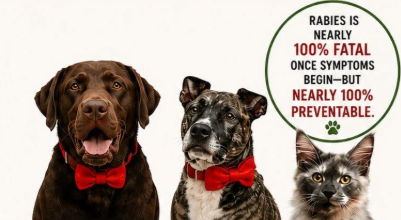
Rabies isn’t just that disease you remember from Old Yeller, Cujo, or an episode of House. It’s a real virus, it’s almost always fatal once symptoms develop — and it’s here in Ohio.
Recently, a bat found in Orange Township in Delaware County tested positive for rabies, bringing the issue especially close to home for families in Dublin and the surrounding area. The good news is that rabies is also one of the most preventable deadly diseases we know.
Why Are We Talking About Bats?
When most people picture a rabid animal, they may imagine a snarling dog or an aggressive raccoon. In Ohio, however, bats are an especially important source of rabies exposure.
In fact, as of June 8, all 15 animals that had tested positive for rabies in Ohio in 2026 were bats. Additional rabid bats have been identified in Ohio since that report.
That doesn’t mean bats are inherently dangerous. Bats are an important part of our ecosystem, and the vast majority are not rabid. But because rabies does occur in Ohio’s bat population, any potential contact with a bat needs to be taken seriously. One of the biggest challenges is that a bat bite can be extremely small and may not leave an obvious mark.
That means you can’t necessarily look at yourself, your child, or even your pet and confidently rule out an exposure simply because you don’t see a bite.
A Heartbreaking Reminder of Why Bat Exposure Matters
A recently published medical report about an 11-year-old boy in Ontario illustrates just how easily an exposure can be missed.
While sleeping at a cottage in 2024, the boy woke to find a bat lying across his nose and mouth. His father captured the bat and released it outside. Because the family couldn’t find a bite or scratch and the bat hadn’t appeared obviously sick, they didn’t seek medical treatment.
Nineteen days later, the boy began developing neurologic symptoms. He was ultimately diagnosed with rabies and tragically died.
His case received renewed attention in 2026 when his physicians published a detailed report in hopes of increasing public awareness. It’s an awful story, but an important one: you do not need to see a bite mark for a bat encounter to warrant concern.
What Counts as a Possible Bat Exposure?
An obvious bite or scratch certainly counts, but those aren’t the only situations that can be concerning.
According to local public health guidance, a bat found in a room with someone who was sleeping may constitute an exposure because the person may not know whether contact occurred. The same concern applies when a bat is found with a young child or someone who may not be able to reliably tell you whether they had contact with it.
And, of course, our pets can’t tell us what happened at all.
If your dog or cat is suddenly interested in something on the floor and you discover it’s a bat, don’t assume there was no contact just because you didn’t witness a bite.
If You Find a Bat in Your Home, Don’t Immediately Let It Go
This is one of the most important things we want pet owners to know.
If a bat has potentially been in contact with a person or pet, don’t simply open the door or window and release it before speaking with the appropriate professionals. If it can be done safely, the bat may be able to be captured and tested for rabies. Testing can provide extremely valuable information when determining what needs to happen next.
For a possible human exposure, contact your local health department and healthcare provider promptly. For a possible pet exposure, contact your veterinarian as soon as possible.
Never handle a bat with your bare hands.
Why Your Pet’s Rabies Vaccine Matters — Even for Indoor Pets
We sometimes hear, “But my cat never goes outside.” Unfortunately, bats don’t always respect that arrangement.
They can enter homes through very small openings, chimneys, attics, vents, damaged screens, or an open door. An indoor cat who discovers a bat before you do can still be exposed.
Keeping your pet’s rabies vaccination current gives them an important layer of protection if the unexpected happens. It can also make an enormous difference in what happens after a potential exposure.
Under Ohio’s rabies rules, a currently vaccinated dog or cat exposed to a known or potentially rabid animal can generally receive an immediate rabies booster and undergo a 45-day quarantine.
The situation can be much more serious for an unvaccinated pet. Depending on the circumstances, Ohio regulations can require strict isolation for months — or even euthanasia. That’s a situation we never want one of our patients or their families to face because a vaccine was allowed to lapse.
Rabies Is Rare in People — Because Prevention Works
Every year, Ohio investigates more than 20,000 animal bite exposures and approximately 1,000 non-bite exposures, involving more than 21,000 people.
Despite all of those potential exposures, human rabies remains extraordinarily rare in the United States. That’s not because the virus has disappeared.
It’s because we have incredibly effective tools to prevent it: vaccination of our pets, appropriate testing of animals after potential exposures, public-health monitoring, and prompt post-exposure treatment for people when it’s needed.
Rabies is almost always fatal once symptoms develop — but it is also almost entirely preventable when we act before that happens.
Why Good Life Requires Rabies Vaccination
Because of the seriousness of rabies and our responsibility to protect our patients, clients, team, and community, Good Life Veterinary Care requires our canine and feline patients to have a current rabies vaccination or an appropriate veterinarian-documented medical exemption.
If your pet received their rabies vaccine somewhere else, that’s completely fine — we’ll just need documentation of the veterinarian-administered vaccine for their medical record.
This isn’t a policy we created because we think every pet is likely to encounter a rabid animal. We created it because rabies is one of those diseases where the consequences of being unprotected can be enormous, while prevention is safe, effective, and readily available.
Not Sure When Your Pet’s Rabies Vaccine Is Due?
Give us a call. We’re happy to check your pet’s medical record, help determine when they’re due, or update their vaccination if needed.
And if your pet ever has an encounter with a bat or other potentially rabid wildlife, call us right away — even if you can’t find a bite or scratch. When it comes to rabies, prevention really can make all the difference.